
One month is gone now out of twelve in the year 2026.
You have had the opportunity to try for your New Year health resolutions. You may have had some success. And perhaps many failures too.
Now, the failures may tempt you to give up. I suggest that you put them to another use. Use them to refine your goals and redefine your strategies instead.
This article will show you how to do just that.
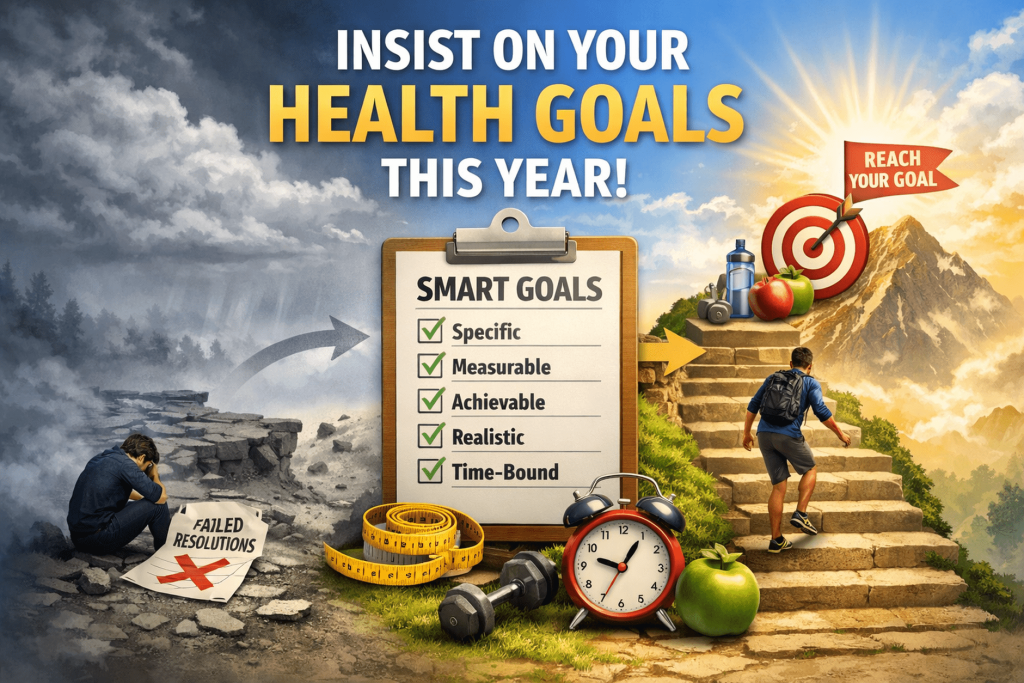
Goals Versus Resolutions
A goal that is achievable aligns with the SMART criteria.
That is, goals are specific, measurable, achievable, realistic, and time-bound.
Resolutions may not be so precise in their formulation, but they still have their advantages. I mean that it is good to say, for example, “I want to lose weight this year.” That is a resolution. It gives the general aspiration and inclination you will aim at for the rest of the year.
But it would be unwise for you simply to stay at that level. You need to sharpen your aspiration from an ordinary wish to a laser point. So, you will say instead, “I want to lose 5% of my body weight by June this year.” That way, it has ceased to be a wish and has become a goal.
Get SMARTer
Specific and Measurable
Stumbling and tripping through a fog—that’s how vagueness can sabotage your goals.
So don’t be vague. Specify and use metrics in goal setting.
Don’t say, I’ll lose weight. State how many kilograms, or what percentage of your body weight.
Don’t say, I’ll exercise more. State what kinds of exercise and for how long.
Your dream is measurable and can be defined. Do that, and it will no longer be merely a dream but a goal—and soon enough, an achievement.
Achievable and Realistic
It’s great to be ambitious. But you can be too ambitious.
Phase out bad habits gradually. That gives your body time to adjust to change and to get used to novelty.
Do you want to cut sugar or salt in your diet? Instead of going completely cold turkey, why not plan to reduce it gradually—say, no more than two cubes a day for two weeks, then one cube for the next two weeks, and then no added sugar thereafter.
Time-Bound
When setting a deadline or timeline for your goals, you should be both generous and ambitious. It is often better to err on the side of generosity.
Give yourself ample time: an ultimate end date when you will have completed the goal, intermediate dates when you will have achieved each task, and regular checkpoints when you will measure how close you are to success.
Failure is painful. But it can push you in the right direction. Don’t retreat. Rather, redefine and restrategise for your health goals this year. You’ll be glad you did.
Are you interested in learning healthy habits? Here are 10 habits for a healthy heart you should adopt in 2026.