
In the middle of this month [May, 2026], a global assembly of gynecologists announced a radical decision. They have changed the name of a common condition. Previously named PCOS (polycystic ovarian syndrome), it is now to be called PMOS (polyendocrine metabolic ovarian syndrome).
To change this condition’s name, it took 14 years and thousands of contributors, including a diverse selection of doctors and other healthcare practitioners, as well as patients and patient advocates. Numerous surveys and endless deliberations also went into the process.
But why all this effort? Why was PCOS’s name changed?
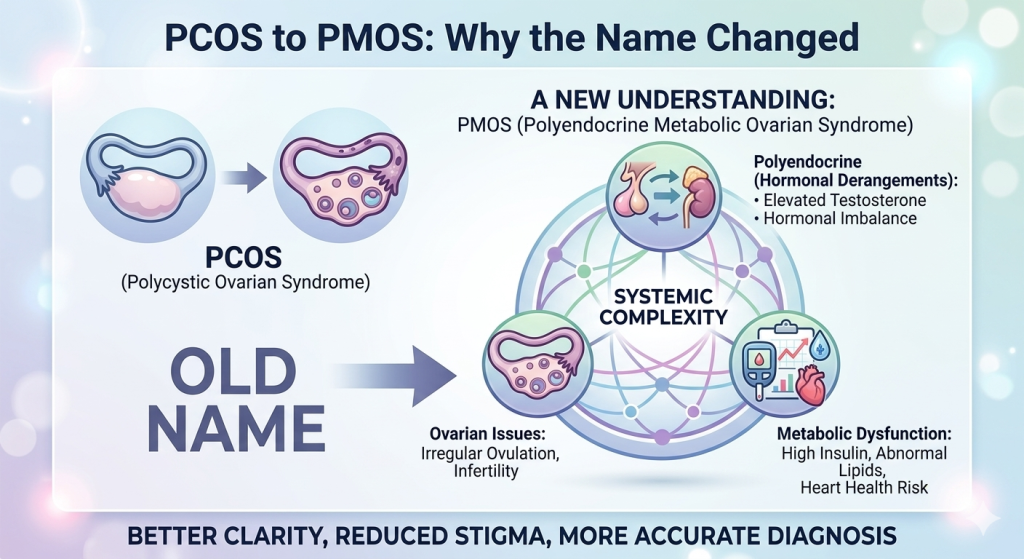
The new name PMOS better represents the complex and multiple contributors to the condition. This reduces misunderstanding, stigma and delayed diagnosis
Diseases with Previous Name Changes
PCOS is not the first disease to undergo a name change. Many diseases in the past have had their names changed to reduce stigma, prevent misconceptions, or convey more accurate medical information.
For example:
- Monkeypox was changed to Mpox
- Sjogren’s Syndrome was changed to Sjogren’s Disease
- Mongolism was changed to Down Syndrome
But none of these previous cases came with as much fanfare as the name change of PCOS!
PCOS to PMOS: What is in a name?
1. The misleading suggestion of multiple abnormal cysts in the ovary
When people hear “ovarian cysts,” they think of massive, fluid-filled sacs in their ovaries, but that’s not what is actually happening in PCOS. Patients do not have massive cysts. Instead, they have multiple small-sized ova (eggs) that have become stuck at a certain level of development, making them appear on scans as small “cysts.”
Therefore, the name PCOS gives a false and misleading impression about its cardinal feature—namely, that the condition is simply about having many abnormal ovarian cysts. However, there are far more systemic problems involved.
2. The incomplete description of the disease given by the name PCOS
There are more features to this condition than appear in an ovary-centered name.
These are:
A. Infrequent or absent ovulation which manifests in a woman’s body as irregular or infrequent menses.
B. Hormonal (or endocrine) derangements: A wide variety of hormones are set at abnormal levels in PMOS. These include reproductive hormones like testosterone (which is unduly elevated), progesterone, FSH, and LH, as well as general metabolic hormones like insulin. The effect is a kind of masculinization of the affected female body. Thus, these women may have excess facial hair, a deeper voice or troubling acne.
C. Metabolic dysfunction: PCOS is deeply associated with the dysfunctional use of energy in the body. This commonly appears as:
- High blood glucose levels
- A tendency to be overweight or gain weight easily
- Abnormal lipid (cholesterol) levels
Eventually, all of these metabolic risks can combine to endanger long-term heart health.
So, we see there is far more to this condition than merely ovarian issues. Therefore, to capture all the systemic problems of this disease in a single phrase, the name was changed to polyendocrine metabolic ovarian syndrome.
Why Does This Matter?
Having the name changed from PCOS to PMOS provides much-needed clarity to the 170 million women worldwide who live with this condition. A much needed relief! Because in the past, the misleading name “PCOS” had several additional negative effects:
3. Hindering Diagnosis
Because of the misconception posed by the unifocal name “polycystic ovarian syndrome,” women with obvious metabolic signs—like excessive facial hair and obesity—frequently failed to be promptly diagnosed as the women did not suspect that what they had was infact PCOS.
4. Fueling False Expectations
Some women diagnosed with PCOS may have expected that a simple surgical removal of the ovarian ‘cysts’ would bring a cure. In fact where quacks abound mismanagement along this line has no doubt occurred. But the name “polyendocrine metabolic syndrome” rightly indicates that the condition is a complex chronic condition that is not amenable to quick ovarian fixes.
5. Grounding of Stigma
The prominence of the word ‘ovary’ in the old name foregrounded reproductive inability. In certain cultures, this can trigger simplistic associations as well as the stigma of ‘barrenness’. The new name, however, does not seem to suggest such stigma as easily.
Conclusion
This name change is another victory for truth, clarity, and women’s health. The ultimate lesson to learn here is that names matter.
Read our article on one of the most curiously named diseases in medicine: Sjogren’s Disease.









. Discover the insightful medical reasons behind this historic change and how it impacts diagnosis, stigma, and treatment for 170 million women worldwide.)