“The shaking palsy.” That was how Dr. James Parkinson described this disease in the early 1900s. Since then it has been recognized as a common neurological disorder affecting every 1 in 600 persons. Parkinson’s disease is very common but relatives and patients often overlook it because they misattribute the symptoms to “old age”.
This post therefore will explain the risk factors, symptoms and problems of people living with Parkinson’s disease.
Risk Factors
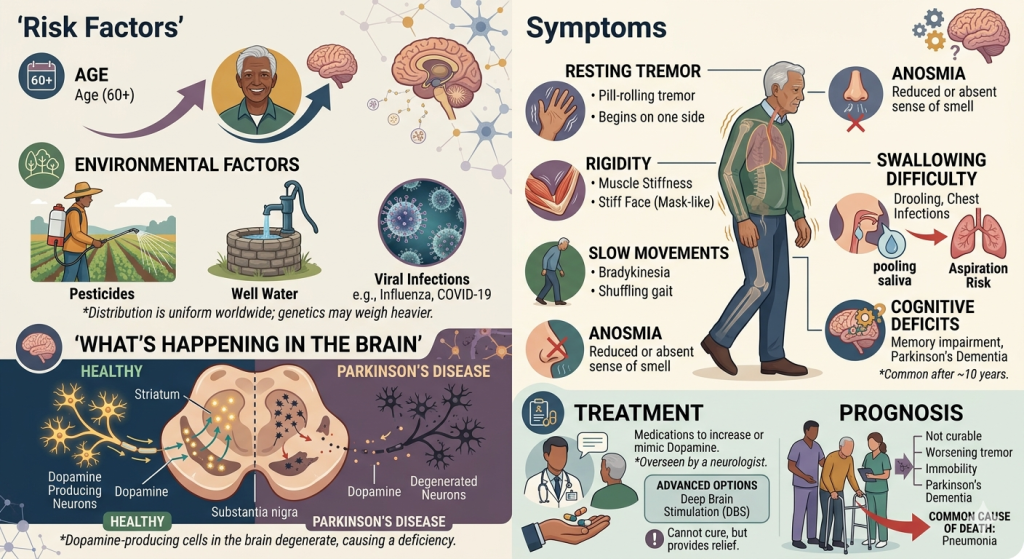
- Age: The risk of developing Parkinson’s disease shoots up with age. People above 60 years should watch out.
- Pesticides: There is an established link between exposure to pesticides earlier in life and developing Parkinson’s disease later. Hence farmers are at heightened risk.Well water: Some studies in the United Kingdom have identified a link between drinking well water and developing Parkinson’s disease.
- Viral diseases: Though uncertain, some scientists have proposed that certain viral infections are linked with Parkinson’s disease later in life. These include influenza, such as in the 1920 pandemic and even COVID-19.
A caveat: The distribution of Parkinson’s disease is uniform worldwide – that is, you are just as likely to get Parkinson’s disease in Toronto as in Taraba. This means environmental risk factors like the ones I have just mentioned may not play a big role in determining who will or won’t get Parkinson’s disease. Rather genetic factors may weigh heavier in this balance.
Symptoms of Parkinson’s Disease
- Tremor: A universal feature in Parkinson’s, this tremor is described as a resting tremor, that is, it is more noticeable when the patient is resting rather than moving. The tremor first begins on one side of the body and after some years, involves the other side. Also, it begins slowly and lightly. It then worsens gradually over time and may eventually become almost unbearable after several years of the disease.
- Rigidity: This begins with one side of the body getting stiffer. And that side remains worse as the disease progresses. All muscle groups may become involved, including the face. This leads to them having an expressionless face described as “mask-like.” Also their legs, giving them a “shuffling” walking style.
- Slow movements: This combined with rigidity can eventually almost totally immobilise them in advanced disease.
- Anosmia: Reduced or absent sense of smell
- Difficulty swallowing: Saliva pools in the mouth and food fails to “go down” easily. Besides the social problems associated with public drooling, there are more sinister possibilities. The food or saliva may pass the wrong passage and go down the lungs instead of the stomach. This is called aspiration and it causes chest infections, some of which prove, at last deadly.
- Cognitive deficits: Memory impairment, difficulty with use of words and appropriate social behaviour are signs of Parkinson’s dementia. This commonly occurs about 10 years after the onset of movement problems. This significantly worsens the patient’s quality of life and compounds the difficulty of providing care as a caregiver.
What’s Happening in Parkinson’s Disease?
The substantia nigra is a portion of a part of the brain responsible for controlling posture and movement. One important neurotransmitter used by the substantia nigra is dopamine. In Parkinson’s disease there is degeneration of the substantia nigra as well as reduced dopamine levels in the neurons. Also abnormal protein misfolds begin to appear scattered all over the cerebral cortex. These explain both the slowing of movement and the cognitive decline that comes later.
Treatment
A neurologist, preferably a specialist in movement disorders, oversees the management of Parkinson’s disease. These medications provide relief for symptoms but cannot cure. Later, the disease may become very poorly responsive to symptoms.
Parkinson’s disease is treated with medications that increase dopamine in the brain or mimic its effect in the neurons.
The specialist can respond by: (a.) carefully adjusting the dose and choice of these medications (b.) exploring other treatment options like deep brain stimulation.
Prognosis
Parkinson’s disease, as mentioned before, is not curable. Even on medications, after many years the disease can worsen with movement difficulty and tremor greatly reducing quality of life. Moreso, there is the possibility of Parkinson’s Dementia as explained above. The commonest cause of death is pneumonia from aspiration and immobility.
Conclusion
Remember that not every abnormal movement is old age. So don’t hesitate to go see the doctor one you notice persisting signs like we have described.