
The Caesarean section is a surgical operation done to extract a baby from the womb by making an incision on the abdomen and on the womb.
The origin of the name Caesarean section is uncertain. But it likely comes from a law promulgated by the Caesars (rulers of the Roman Empire) which mandated that babies be cut out of dead or dying mothers rather than being buried with them.
How Common are Caesarean Sections?
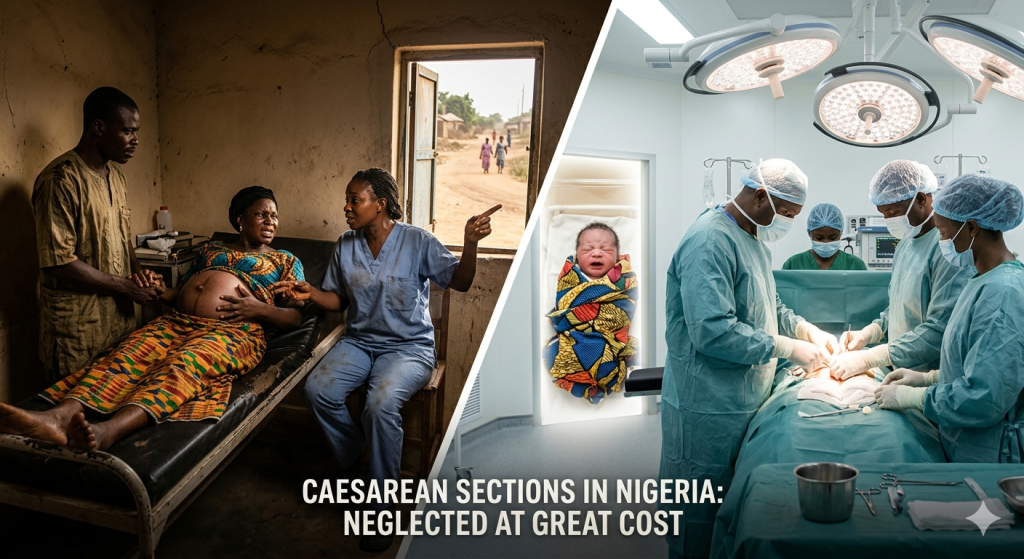
Too Few in Nigeria
The Caesarean section (CS) is a life-saving surgery. But in Nigeria only about 2.1% of childbirths are via CS. But the WHO expects that 10-15% of childbirths should be via CS. This means that Nigerians are very likely underutilizing this important operation.
Too Many Globally
On the other hand, in many countries like the United States, about a third of their childbirths are via CS. This means that they are possibly overutilizing this surgery and performing unnecessary operations. The surgeons most likely do this out of an overprotectiveness against lawsuits which may arise from a vaginal birth gone awry. In Nigeria, however, particularly in some unscrupulous private hospitals, this kind of abuse is also possible. But the reason is different. Over here, some doctors deceive pregnant women into performing unnecessary CS for the financial gain they get from the surgery.
All this notwithstanding, in Nigeria, the far bigger problem is that we are not doing enough Caesarean sections. For several reasons like:
Why Does Nigeria Have So Few Caesarean Sections?
- Access: Many Nigerians live in rural areas several kilometers away from a hospital where they can access any safe maternal care at all, not to mention a Caesarean section.
- Cultural beliefs: Some Nigerians have the notion that a woman who cannot ‘push out’ her baby via conventional labour is somehow less of a woman. In addition, Nigerian women many times are not empowered to make autonomous decisions regarding their own bodies or their reproductive health. Hence, husbands may decline or delay a CS even when it has be recommended to save the woman or her child. The religious expectation of miracles or divine help during childbirth may also play a role here.
- Quacks: Many Nigerians see orthodox medicine (and surgery!) as a last resort. They will first use traditional medicine providers whom they judge a cheaper and more trustworthy alternative.
- Cost: Caesarean sections are not cheap, even in government hospitals.
- Fear: Fear is an understandable response to the prospect of surgery. But women may overestimate the length, extensiveness, risk or recovery time of the surgery and so stay away.
Consequences of Poor CS Uptake
High maternal mortality – women die
Nigeria has been described as one of the worst places in the world to give birth. Why? Well, because it has one of the highest maternal mortality rates globally. According to the World Health Organization, Nigeria accounted for about 28.5% of global maternal deaths in 2020, with a maternal mortality ratio of approximately 1,047 deaths per 100,000 live births. Some of the leading causes of death in pregnancy—such as obstructed labour and hypertensive disorders—can be safely managed with a caesarean section (CS). However, the low national uptake of CS means that many women still die from preventable causes.
High maternal morbidity – women suffer
Where a dangerous pregnancy does not kill, it can still maim. Obstetric fistula—one of the major complications of prolonged obstructed labour—affects thousands of Nigerian women. It is estimated that between 12,000 and 20,000 new cases occur annually in Nigeria, with a backlog of over 150,000 untreated cases. These women involuntarily leak urine and sometimes faeces. Many live with a persistent odour, leading to rejection by their husbands and communities, and are often pushed into isolation, despair, and depression. Others develop nerve damage, resulting in weakness in the legs and a lifelong limp.
Poor neonatal outcomes – newborns suffer and die
A difficult birth can exhaust the fetus or even lead to death. Those who survive may develop long-term complications such as cerebral palsy, epilepsy, or intellectual disability. Nigeria’s neonatal mortality rate remains high: according to the United Nations Children’s Fund, about 37 deaths per 1,000 live births occur within the first 28 days of life. This translates to hundreds of thousands of newborn deaths each year. Many of these deaths could have been prevented by a CS.
We’ve seen why people would reject a CS. But why would your doctor request one? Stick with us for a second part of this post where we learn why CS is safe and when you should get one.
Are you interested in learning more about the state of reproductive health in Nigeria? Well, you’re in luck! We have an article on just that topic! Read here.









 is far below WHO recommendations. Explore why Caesarean sections are neglected and the high cost of this underutilization, from high maternal mortality to fistula and poor newborn outcomes. This critical look analyzes barriers like access, cost, and culture.)