This year’s celebration of World Health Day marks the beginning of a year-long campaign that highlights how scientific collaboration helps safeguard the health of humans, animals, plants, and the environment.
On April 7, 78 years ago the World Health Organization was founded. That’s why April 7 every year is celebrated as World Health Day.
Since the middle of the twentieth century till now in the early twenty first century, we have seen numerous dramatic wins in global health, like the eradication of smallpox, the near eradication of polio, as well as the development of effective drugs like antibiotics and anticancer medications.
We have also gotten a better understanding of the close relationship between the health of the planet and of humans, animals and plants. This is why the WHO has dubbed this World Health Day’s theme “Together for health. Stand with science”. Scientific and evidence-based exploration has made this progress possible. But in an age of shrill gainsaying voices denigrating science, it is good to remind ourselves of what we have achieved so we can push further.
This post, therefore, will be highlighting the more significant triumphs of global health we have achieved in the past 80 years.
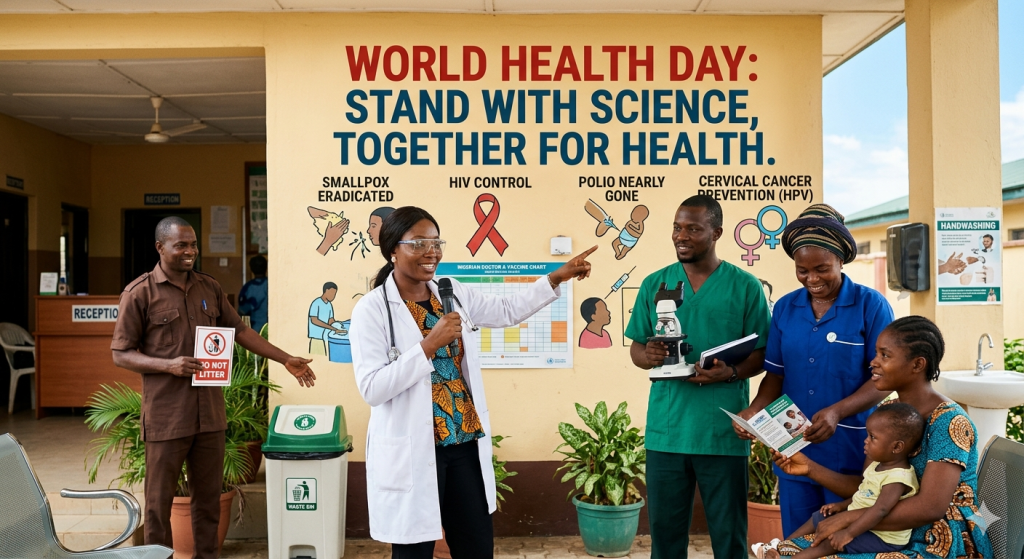
1. The eradication of smallpox
You never have (and never will) see a case of smallpox because the disease was eradicated from the whole world in 1980. This deadly disease was responsible for numerous epidemics in history, even notoriously being used by early European colonists to terrorize the non-immune native American population. But over 40 years ago, by cooperation among most countries globally and the scientific tools of vaccination, surveillance and intense case control, the human race was able to completely eradicate smallpox from off the face of the earth. Read that again, and consider: humans have what it takes to cancel a disease from existence.
2. The control of HIV/AIDS
When HIV appeared in the 80’s, it was a death sentence. Almost no one survived. Spread was likewise uncontained. Blood transfusion was a landmine; sexual relationships a timebomb. Babies born to infected mothers were not safe. But in less than 2 decades after the discovery of HIV, scientists created effective drugs. Now people living with HIV can live a near-normal lifespan like any other person. Effective screening methods have made blood transfusions safer. Pre-exposure prophylaxis allows for safe sex even with an HIV-infected spouse. And babies don’t have to be condemned to live with HIV even when born to a HIV-positive mother any longer.
3. The near eradication of polio
Most countries (including Nigeria since 2020) have already eliminated wild polio. Only Afghanistan and Pakistan remain. This means Nigerians can no longer be infected by the wild type of polio again. Note however that the paralysis caused in the past by the wild polio is lifelong even though the virus no longer resides in the body. Again, mostly through wide vaccination coverage the world has nearly (and will likely soon totally) rid the world of this crippling disease.
4. The key to cervical cancer
Cancer of the cervix is the commonest cancer of the female reproductive tract and kills over 8000 Nigerian women each year. But we have found out that the biggest risk factor for cervical cancer is a preventable infection by a germ called the human papilloma virus (HPV). Vaccines were developed to help prevent this infection. And in countries like Australia and England where the HPV vaccination program is established, cervical cancer has very nearly been eliminated. In fact 90% of all new cases of cervical cancer appear in lower and middle income countries with poor vaccination status. So, now with a simple jab, you can save your daughter from a common cancer.
Conclusion
The triumphs of global health were birthed by nations uniting. But united nations start from united persons – individuals like me and you – we’re the ones who can improve our own health by standing with science. Do the little things and urge others to do them too. Don’t litter. Wash your hands. Don’t dump your refuse in the open. Vaccinate your children. Do your pap smear. Do your mammogram. Know your HIV status and stay safe, or start treatment if you’re positive. Know your genotype. Don’t stigmatize those living with chronic diseases. Stand against misinformation and always be learning from experts. Stand with science, together for health.