Sickle cell disease is curable. Does this surprise you? It should not. Out of the two options for a cure, one of them has been practised by physicians for over 30 years. This is what is colloquially called bone marrow transplant (BMT). It is more accurately called haematopoietic stem cell transplantation (HSCT). Over 2,000 people with sickle cell disease worldwide have been cured of SCD since 1983, when this procedure was first performed. The second option is gene therapy. This is a newer method which we will discuss in a later article. This current article, however, will focus on bone marrow transplant.
The existence of this cure then raises an interesting question: why, out of the nearly 6 million people living with sickle cell disease in Nigeria, have only a few dozen been cured? Perhaps when we have answered that question, we will have a response to this other pressing query: how feasible is it for me or my child to get cured of sickle cell disease via bone marrow transplant in Nigeria?
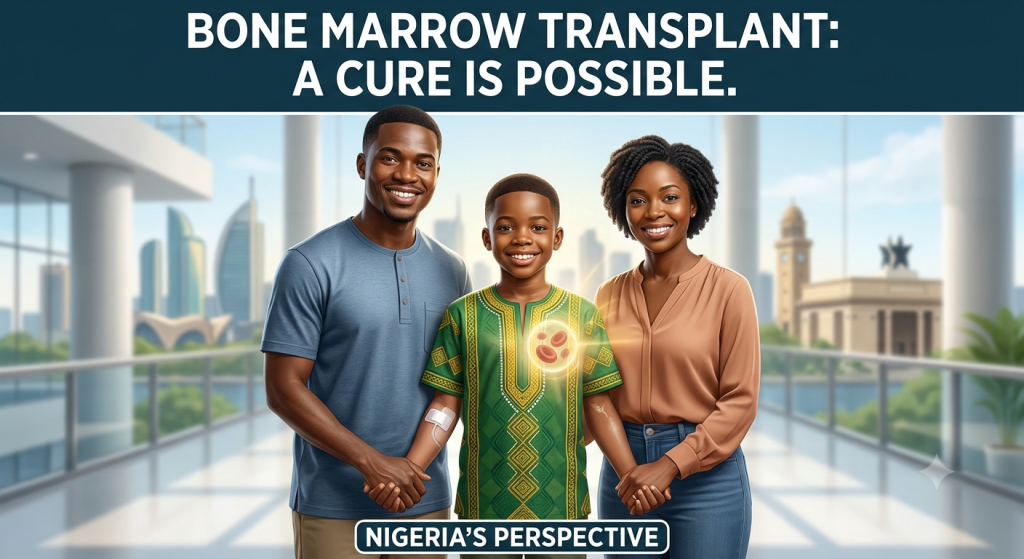
What Is a Bone Marrow Transplant and How Can It Cure Sickle Cell Disease?
In human beings, blood is produced in the bone marrow. The bone marrow of people living with sickle cell disease produces abnormal red blood cells.
A bone marrow transplant aims to permanently replace the defective bone marrow with healthy bone marrow.
First, a suitable donor must be found. This person is usually a sibling. Compatibility is determined by HLA testing.
The stem cells which will develop into new bone marrow may be harvested from the donor’s bone marrow or peripheral blood. Blood from the recipient’s umbilical cord could also be used if it was banked at birth – one benefit of prenatal diagnosis of sickle cell disease.
Next, the recipient undergoes chemotherapy or whole-body radiotherapy. This has two purposes: first, to remove the current diseased bone marrow; and second, to suppress the immune system so that the recipient’s body does not reject the transplant.
The stem cells are then infused into the recipient in a manner similar to a blood transfusion.
The recipient remains in the hospital for weeks after the procedure for close observation while receiving immunosuppressive drugs and being kept in a sterile environment to prevent infections.
If there are no complications, the patient will be discharged. However, he will have to keep using immunosuppressive medications for up to a year while attending regular clinic appointments for close monitoring.
During this time, the transplanted stem cells will settle in the patient’s bone marrow and establish a new blood-production apparatus which will produce non-sickling haemoglobin, thus effecting a cure.
How Successful Is Bone Marrow Transplant for SCD?
About 90–95% of transplant patients are effectively cured without major complications. Children generally have better outcomes than adults.
It is important to note that while complications of sickle cell disease like stroke, kidney disease and femoral head necrosis are reasons for a bone marrow transplant, where these complications have already occurred, a BMT will not reverse them. It will, however, stop the disease from progressing.
Is Bone Marrow Transplant Available in Nigeria?
Nigeria is among the seven African countries where you can obtain a BMT.
However, the procedure is only available in a small number of centres in Nigeria – about eight of them. The University of Benin was the first centre to perform a BMT on a seven-year-old child with SCD, which was successful. The Lagos University Teaching Hospital and the Sickle Cell Foundation of Nigeria have arranged a subsidy for 10 low-income Nigerians to have a BMT.
How Much Does It Cost?
Cost is one of the biggest barriers to obtaining a BMT. Estimates online range from ₦24 million to ₦80 million for the whole procedure.
Consider that you are not paying just for the transplant but for the whole sequence of care, which includes:
- HLA/donor testing
- investigations and preparation
- chemotherapy/conditioning
- hospital admission
- transfusions and medications
- infection prevention and treatment
- prolonged follow-up
SCD itself, when untreated, has been shown to cause catastrophic health spending in nearly a quarter of affected households. So one must choose what one would rather spend on.
How Rigorous Is the Treatment?
A BMT is not an easy “one-time cure.” It requires a period of initial preparation and prolonged follow-up involving the steps I described earlier but summarise below:
- donor matching
- conditioning chemotherapy
- transplantation
- immunosuppression
- prolonged monitoring
Therefore, you must be committed to a patient and arduous journey if you are considering a BMT.
What Are the Risks?
Graft-versus-host disease (GVHD): This occurs when transplanted immune cells attack the organs of the recipient. It is a major cause of death and serious complications after a BMT. Complications can arise within days to weeks following transplantation or months to years afterwards. It is generally less common in younger patients.
Graft failure/rejection: The transplant may be rejected by the body’s immune system and so fail to become established.
Serious infections: Immunosuppressive drugs are given to prevent the recipient’s body from rejecting the transplant. However, this has the unfortunate risk of exposing the patient to overwhelming infections.
Infertility: The chemotherapy used to prepare a patient for a BMT can cause infertility. Doctors therefore advise banking sperm cells or ova before commencing treatment.
Secondary cancers: Cancers like leukaemia can likewise appear later in life as a result of the conditioning chemotherapy.
Death: Any of these complications can result in death.
Be reminded that 90–95% of transplants are successful, with the patients still alive and fairly healthy five years after BMT.
Conclusion: Cure Is Possible, but Prevention Is Better
Bone marrow transplant has transformed what is possible for people living with SCD, but it remains expensive, rigorous and risky. Prevention through genotype testing, genetic counselling and informed reproductive decisions remains better. For those already affected, however, prevention is no longer an option—but hope is. Sickle cell disease need not always be a lifelong sentence.