
In the first part of this post, we deconstructed a common Nigerian image of people living with schizophrenia. There are other myths about schizophrenia which are widely believed. We will look at some of them in this post.
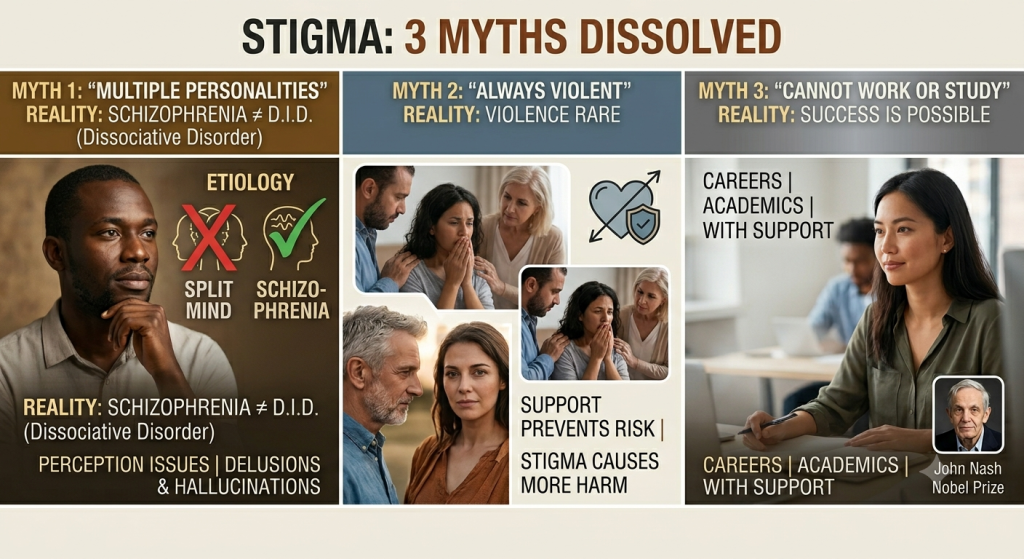
Myth 1: Schizophrenia Means “Multiple Personalities”
Some people define schizophrenia using its Greek etymology, which literally means “split mind.” They then interpret this as a disorder in which multiple personalities exist within one body. But that is not what schizophrenia is.
Rather, this describes a different condition known as dissociative identity disorder. Schizophrenia is a mental illness characterized by disruptions in perception of reality, thinking, and emotions. It is commonly associated with hallucinations and delusions.
It is important to know that the name “schizophrenia” was coined at the dawn of modern psychiatry, when our scientific understanding of mental illness was still developing. Even then, the psychiatrist who introduced the term in 1908, Eugen Bleuler, did not mean multiple personalities. He was referring to a loosening of the normal association between mental processes such as thinking, emotion, and perception.
But we are wandering too deep into mental theory. Let’s come back to earth.
The false assumption that schizophrenia is a multiple-personality disorder has sometimes motivated people to link it to demon possession. This, of course, can fuel stigma and discrimination. But just as the elderly can experience a breakdown in cognition and we call it dementia, so anyone can experience a breakdown in mentation, in a certain pattern, and we call it schizophrenia.
Myth 2: People With Schizophrenia Are Always Violent
Though the media often portrays otherwise, most people with schizophrenia are not violent. Only a minority will ever become violent, and when violence does occur, it is often directed toward family members or other people close to them rather than strangers.
Violence is also more likely when certain risk factors are present, such as:
- An acute psychotic episode involving persecutory delusions or command hallucinations
- Alcohol or drug abuse
- A history of previous violence
In fact, people living with schizophrenia are far more likely to be victims of violence than perpetrators of it. Cognitive difficulties may make them vulnerable to exploitation, while stigma itself can expose them to abuse and mistreatment.
Remember this striking fact: for every homicide committed by a person living with schizophrenia, there are many more deaths by suicide among people with the illness. The stereotype of the dangerous schizophrenic does far more harm than good.
Myth 3: People With Schizophrenia Cannot Work or Study
It is true that schizophrenia can make studying or working more difficult. The illness can affect thinking, concentration, and motivation. Medications may sometimes slow a person down. Acute psychotic episodes can be disruptive, and many people require support in navigating social settings.
But difficulty does not mean impossibility.
People living with schizophrenia can work, study, and excel. The example of John Nash—the mathematician who lived with schizophrenia and later won the 1994 Nobel Prize in Economics—beautifully illustrates this.
If you are living with schizophrenia, your skills, interests, and tolerance for stress can help determine a suitable career path or course of study. Flexible jobs such as online writing, graphic design, or software development may be excellent options, depending on your abilities and preferences.
What is most important is to have supportive friends, family members, teachers, or employers. Such people can help alleviate stigma and provide a steady anchor when the pressure seems to be piling up.
Conclusion
People living with schizophrenia are more like you than you think. Stick with the truth and shun stigma.