Do you jump when you hear the phrase “brain tumor”? Should you? Is it because you think brain tumors are always deadly? Or do your constant headaches make you wonder if you have one?
Knowledge, they say, is power. This article aims to empower you to live without undue fear by presenting seven facts every Nigerian should know about brain tumors.
1. Not Every Brain Tumor Is Cancer
Tumor ≠ cancer. They are not the same thing. Rather, cancer is a type of tumor.
A tumor is a mass of tissue whose growth is no longer properly regulated. It therefore grows out of proportion to the rest of the body.
Tumors occur in all parts of the body, including the brain. But not every brain tumor is cancerous. Brain tumors may be either benign or malignant. Benign tumors usually grow slowly and are less likely to spread into surrounding tissue. Malignant (cancerous) tumors grow more quickly, invade nearby tissue, and are more likely to recur after treatment. About 70% of brain tumors are benign.
Now note that benign tumors are not automatically safer. Because the brain is enclosed within the rigid skull, even a benign tumor can compress sensitive brain tissue, causing neurological problems and dangerously increasing pressure within the skull.
Therefore, every brain tumor must be evaluated individually to determine its risk.
2. Persistent Headaches Are Only One Possible Symptom
About half of people with brain tumors experience persistent headaches. These headaches often have a peculiar character. They may be:
- Worse in the morning
- Worse with straining, such as during bowel movements
- Accompanied by early morning vomiting
Depending on where the tumor is located, other symptoms may include:
- Seizures
- Vision problems
- Weakness of an arm or leg
- Personality or memory changes
- Difficulty speaking
Headache is a very common symptom with many possible causes. But if you develop a new, severe, long-standing headache or notice unusual neurological symptoms alongside your “usual headache,” you should see a doctor.
3. Brain Tumors Can Affect Young People Too
Brain tumors are more common in older adults, especially those over 60 years of age. But they can occur in young people too. In fact, they are the commonest solid tumors in children.
If you’re a parent, pay close attention to your child. Persistent seizures, repeated vomiting, difficulty walking, or other neurological symptoms should be reported to a doctor promptly.
4. Radiation Can Cause Brain Cancer—but Not from Mobile Phones
Many Nigerians believe radiation from mobile phones causes brain cancer. However, there is no convincing scientific evidence to support this.
There is, however, a type of radiation that can increase the risk of brain tumors. It is called ionizing radiation. In high doses—such as from atomic bomb exposure or radiotherapy used to treat other cancers—it can damage DNA in brain cells and increase the risk of developing a tumor.
5. A Healthy Lifestyle Cannot Guarantee Prevention
Exercise, a healthy diet, and avoiding smoking and excessive alcohol can reduce the risk of many diseases, including hypertension, type 2 diabetes, and several cancers. However, they have not been shown to prevent brain tumors.
In fact, only a few risk factors are firmly established. These include exposure to ionizing radiation and certain rare inherited conditions such as neurofibromatosis and tuberous sclerosis.
The upside is this: if you develop a brain tumor, it is almost certainly not your fault. There is probably nothing you could have done either to cause it or to prevent it.
6. Early Diagnosis Can Make a Big Difference
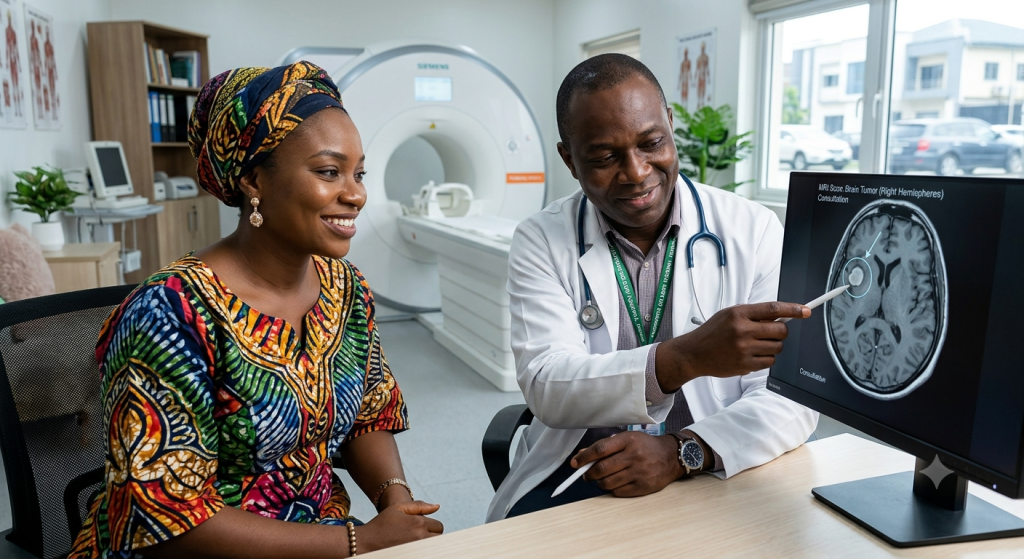
Remember the symptoms we discussed earlier? If your doctor suspects a brain tumor, they may request a CT scan or an MRI scan. If a tumor is found, a sample may be taken and examined in the laboratory to determine its type. This is called a biopsy, and it helps guide treatment.
It is important to begin treatment promptly—even for benign tumors. Some benign tumors can become more aggressive over time, and almost all brain tumors can increase pressure within the skull and threaten life if left untreated.
Are you having persistent headaches, seizures, or impaired vision? Don’t self-medicate. Don’t delay. Don’t try native medicine first. An oversight here may prove too costly.
7. Many Brain Tumors Can Be Treated
A brain tumor is not necessarily a death sentence. Many can now be treated using one or more of the following:
- Surgery
- Radiotherapy
- Chemotherapy
- Targeted therapies (for selected cases)
The type of tumor, its size, and its location will determine the treatment your doctor recommends.
Conclusion
Here, then, are seven surprising facts about brain tumors. If you have persistent neurological symptoms, seek medical attention promptly. And share this article far and wide. Everyone deserves to know.